
What Actually Ages Inside a Transformer
The insulating paper. Cellulose insulation degrades progressively under the combined action of heat, oxygen and moisture — and the higher the temperature, the faster it degrades.
The winding conductor is not the component that limits transformer life, and neither, in the short term, is the insulating oil. If oil performance drops, it can be reconditioned or simply replaced.
What cannot be replaced is the paper. It performs two jobs. The first is insulation: dielectric strength comes from oil and paper together, and the paper is the half that cannot be renewed. The second is mechanical support. The winding is held in position by it — during a short circuit the current surges and pushes the winding outward, and it is the paper that keeps it in place.
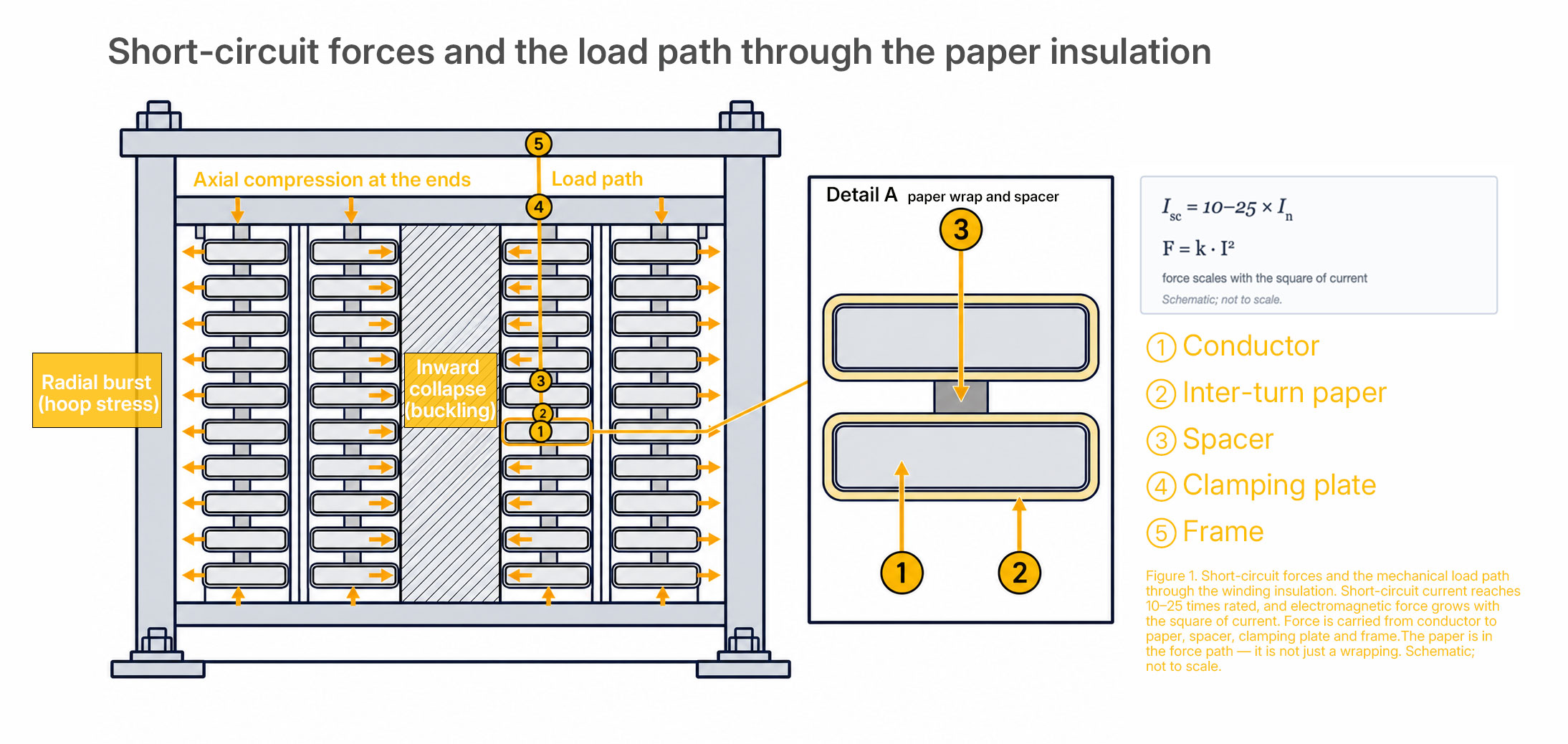
Only with this distinction in mind can ageing assessment results be read correctly. The assessment does not predict the day the transformer will fail; it measures how much mechanical strength the paper still has, and how many short circuits it can still withstand.
Once a criterion is set for the strength margin, condition can be translated into time. The industry generally treats a degree of polymerization (DP) of around 200 — or 50% retained tensile strength — as end of life: the point at which the paper is too brittle to be relied on to hold the winding. Dividing the remaining margin by the current ageing rate gives the number of years left. That rate in turn depends on temperature and load: the hotter the winding and the heavier the load, the faster the paper is consumed.
Hot-Spot Temperature, Not Average Temperature
Ageing is referenced to the hottest spot in the winding, which is not the temperature any thermometer on the tank reports. It is a calculated internal value: oil temperature rise in the duct, plus the winding-to-oil gradient, plus a local allowance for the region where the hottest conductor sits and where cooling is poorest.
Three quantities feed it. Load raises the conductor loss, and loss rises with the square of current. Ambient sets the starting temperature of the oil that removes the heat. Cooling class sets how much heat the system can move at a given temperature difference; a design that relies on natural circulation loses capacity faster than one with forced circulation, and a failed pump or fan changes the calculation entirely.
The consequence is that capacity and life are not independent. Two units with the same nameplate rating but different cooling design will have different hot-spot temperatures at the same load, and therefore different ageing. Comparing nameplate ratings compares outputs, not duty.
How IEC 60076-7 Turns a Load Profile into Consumed Life
IEC 60076-7, the loading guide for oil-immersed power transformers, treats insulation ageing as a function of hottest-spot temperature and the time spent at that temperature. Its ageing model is exponential: the rate rises steeply as the hot spot rises, and the guide normalises that rate against a reference hot-spot temperature, so the output is a relative ageing rate rather than a number of years.
The practical procedure has four steps.
- Define the load profile over the period of interest — not a single figure, but the daily and seasonal shape, including the sustained periods rather than only the peaks.
- Calculate the hot-spot temperature at each step using the transformer's thermal model, its cooling class and the ambient profile.
- Convert each hot-spot temperature into an ageing rate.
- Sum the rates over the profile to get an equivalent ageing value for the period.
The reason the peak is not enough is that ageing is an integral of an exponential. A short excursion to a high hot spot consumes life quickly, but a long plateau at a moderately elevated hot spot can consume more. Which of the two dominates is a property of the profile, and cannot be read from a nameplate.
Why the 6 K Rule Is Useful and Where It Misleads
The familiar statement that the ageing rate doubles for each 6 K rise is a local linearisation of the exponential model around the reference hot spot. It is a reasonable approximation for modest excursions near that reference, and it is a poor one far from it, where the true curve is steeper than the doubling rule suggests.
Two further limits matter in practice.
- The rule says nothing about moisture: as little as a few percent water in the paper can multiply the ageing rate at a given temperature, and moisture moves between oil and paper as the unit heats and cools.
- Nor does it say anything about oxygen, which cellulose ageing is sensitive to and which sealed and conservator designs handle differently.
The rule is therefore a good way to communicate why a hot spot matters, and a bad way to size a transformer. Any comparison of bids on the basis of guaranteed hot-spot rise should ask over which profile the number was calculated.
What a Specification Should State
The table maps each requirement to what it controls and to the evidence a buyer can ask for.
| Requirement | What it controls | Evidence to request |
|---|---|---|
| Load profile | The input to the whole calculation; the shape matters more than the peak | The profile the supplier used, stated in periods and durations |
| Ambient profile | Starting temperature for every step; site records, not a single design maximum | Site temperature record for the design maximum, including daily and seasonal swing |
| Cooling class and redundancy | Heat removal at a given temperature difference, and behaviour with a pump or fan out of service | Cooling design description; rating with cooling stage unavailable |
| Hot-spot limit | The ceiling the design must hold over the profile, not at one operating point | Calculated hot-spot temperature at each profile step |
| Ageing calculation | Consumed life per period, and the reference temperature used | Ageing rate and equivalent ageing over the profile to IEC 60076-7 |
| Moisture and sealing | Whether the ageing model's assumptions survive service | Moisture in paper at factory acceptance; sealing system and IP rating |
Two verification points are worth stating explicitly.
First, hot-spot temperature is a calculated quantity, not a measured one; the calculation should be reviewed for the thermal model, the cooling assumptions and the ambient profile it used.
Second, ageing over a profile is verified by calculation and by the temperature-rise test at rated conditions, not by a life test; if a supplier offers a life demonstration, ask what it actually tested.
Conclusion
Thermal ageing is set by the hot-spot temperature over a duty cycle, not by a rating. Three things most often go wrong: a specification that quotes only a peak load, an ageing calculation presented as a single number without the profile behind it, and a 6 K rule used as a sizing tool rather than as a communication aid. Define the load and ambient profiles, require the calculated hot spot at each step, and ask for the consumed life over the profile in the units IEC 60076-7 provides.